

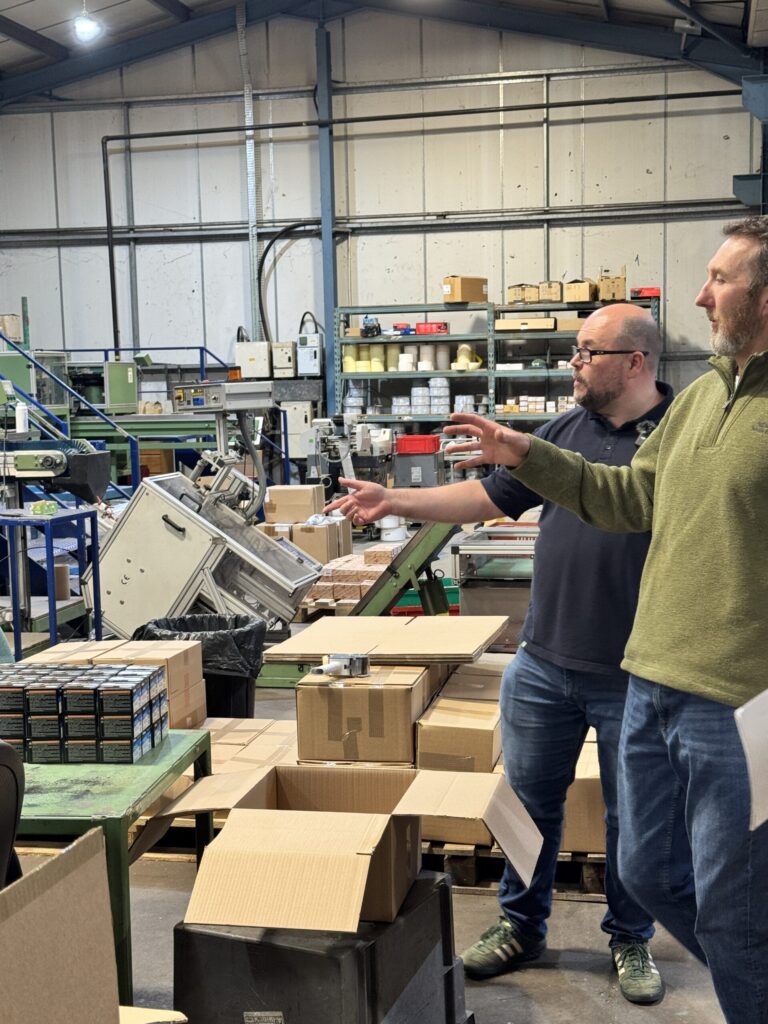
Most manufacturers do not come to Excel because everything is running perfectly.
They usually come to us when packing has started creating pressure somewhere.
Sometimes it is obvious. Boxes are taking over the factory floor, the team is stretched, or orders are getting harder to move out on time.
Other times, the problem is less visible. Packing is quietly eating into profit, pulling people away from production, slowing down growth or creating extra checks nobody really has time for.
Either way, the issue is rarely “just packing”.
Packing affects your space, your team, your costs, your turnaround and your ability to say yes to more work.
So, if any of the following sound familiar, this blog is for you.
Here are the biggest packing problems manufacturers bring to Excel, and how we help fix them.
Problem 1: Packing is taking over your factory floor 📦
This is one of the easiest problems to spot.
Boxes in the way. Pallets waiting to move. Materials taking up corners that were never meant to be packing areas. Finished products sitting around because nobody has had time to sort the next step.
At first, it might feel manageable. You find a bit of space, move things around and make it work.
Then the orders grow.
Suddenly, the “temporary” packing area has become a permanent part of the factory, and everyone is working around it.
That lost space has a cost.
It can affect how much you are able to manufacture, how much stock you can hold, how quickly jobs flow through the building and how calm the day feels.
How Excel helps ✅
We take the packing process off your factory floor and handle it in a space already set up for it.
That means your products can be packed, checked, wrapped and prepared properly without taking over your own site.
For manufacturers, this can be a huge relief.
You get space back. Your team gets room to work. The packing job gets a proper process behind it.
Much better than playing factory-floor Tetris with boxes and pallets every week.
Problem 2: Your team is being pulled away from the work they should be doing
Packing often starts as something your team can “just sort”.
Then it becomes something they are sorting all the time.
A few people are pulled away from production. Someone stays late to finish a batch. Another person has to check labels. Someone else is trying to get products wrapped and ready to move before the deadline hits.
Individually, those moments might not feel like much.
Together, they add up quickly.
The real problem is not just the time spent packing. It is what your team is not doing while they are dealing with it.
How Excel helps ✅
Excel gives manufacturers access to a team that packs, labels, kits, wraps and prepares products every day.
That matters because packing is not something we squeeze in around everything else. It is what we are set up to do.
Your team can stay focused on production, product development, customer orders and the work that actually needs to happen inside your business.
We handle the packing pressure in the background, so your people are not constantly dragged into jobs that could be done elsewhere.
Problem 3: The “quick job” is never actually quick 🐌
Every manufacturer has one. The job that sounds simple until it lands.
It might be a kitting job with lots of small parts. It could be a labelling run that needs careful checking. Maybe it is a repetitive hand-packing task that eats into the day far more than expected.
Everyone thinks it will be quick.
It never is.
These jobs are frustrating because they are not always difficult. They are time-heavy, fiddly and easy to underestimate.
That is where packing problems for manufacturers often start to sneak in.
How Excel helps ✅
We are built for the jobs that need process, patience and consistency.
Kitting, hand packing, labelling, over-labelling, rework and assembly-style packing are all areas where manufacturers often need extra support.
We help by taking those fiddly, repetitive jobs and giving them a proper structure.
The right team, right setup, right checks and the right finish.
That means fewer interruptions for your own team and a smoother route from product to finished job.
Problem 4: Packing is costing more than you think 💷
This is the one many manufacturers underestimate.
In-house packing does not just cost the time it takes to put products into boxes.
You also need to think about:
- Labour
- Floor space
- Machinery
- Servicing
- Electricity
- Training
- Quality checks
- Overtime
- Materials
- Management time
- Mistakes or rework
Once all of that is added up, the real cost can look very different.
A packing process might feel cheaper because it is happening in-house. But if it is using valuable space, tying up your team and slowing other work down, it may already be costing more than you realise.
How Excel helps ✅
At Excel, we already have the team, machinery, space and processes in place.
That means manufacturers can access a proper packing setup without buying the kit, finding the room, training extra people or carrying those costs all year round.
We generally save manufacturers around 30% compared to managing everything in-house.
That saving matters, especially when operating costs are already high and every extra overhead needs to be justified.
Problem 5: Your workload changes, but your costs do not 📊
Manufacturing is rarely perfectly steady.
Some months are busier. Some jobs come in quickly. Seasonal spikes happen. Customer demand changes. New products launch. Order sizes shift.
The problem is that in-house costs do not always flex in the same way.
If you buy machinery, hire people or give up space for packing, you are usually carrying those costs whether the workload is high or low.
That can make growth feel risky.
More work should be a good thing. But if every increase in demand means more fixed costs, more pressure and more internal juggling, saying yes can feel heavier than it should.
How Excel helps ✅
This is where flexible support makes a real difference.
Excel can scale up and down with your workload.
If you have more products to pack, we can support that increase. If you have a larger batch, a busy period or a new product line, we can adapt around what you need.
Then, when things settle back down, you are not left carrying the same level of internal cost every month.
We work like an extension of your own packing department, without you having to build and pay for the whole setup yourself.
That gives manufacturers the confidence to grow without packing becoming the thing that holds everything back.
Problem 6: Products are packed, but not ready to move 🚛
Packing is not finished when the product is in the box.
It still needs to be checked, organised, wrapped, labelled, palletised or prepared for dispatch.
This final stage is often where pressure builds.
If products are packed but not ready to move, your team still has work to do. That can slow dispatch, create extra handling and leave finished goods taking up space for longer than they should.
For manufacturers already managing tight deadlines, that is the last thing they need.
How Excel helps ✅
We do not just pack products and leave the rest to you.
Excel can get products ready to move, whether that means wrapping, palletising, preparing goods for dispatch or organising the job exactly as agreed.
For example, if a customer needs 500 units per pallet box and needs them sending out, that is what we do.
Clear instructions. Proper process. Finished job ready for the next stage.
That is the kind of support that makes outsourcing feel genuinely useful.
Problem 7: You are not sure if outsourcing will actually work 🤔
This is one of the biggest reasons manufacturers delay making a decision.
They know packing is causing pressure, but they are not sure whether outsourcing is the right answer.
That is completely understandable.
You are trusting another team with your products. You need to know they will be handled properly, packed correctly and prepared exactly as agreed.
Nobody wants to hand everything over and hope for the best.
How Excel helps ✅
That is why we offer trial runs.
You can send us one real packing job, and we will pack it and get it ready to move so you can see exactly how the process works.
A trial run helps you test:
- How your product is handled
- How the job is packed
- How much time it saves
- How much space it frees up
- Whether it reduces hassle
- Whether it makes financial sense
No huge commitment, guessing or big scary handover.
Just one job going through Excel so you can see whether outsourcing your packing actually improves things for you.
Why these packing problems matter 👀
Packing problems do not usually stay small.
A bit of lost space becomes a bigger storage issue. A few hours of team time becomes regular overtime. A fiddly job becomes a weekly frustration. A process that used to work becomes a bottleneck.
Before long, packing is affecting more than just packing.
It can impact production, dispatch, costs, team morale and growth.
That is why it is worth looking at the process properly before it becomes a bigger problem.
Final thoughts: if packing is creating pressure, test a better way👇
You do not always need more staff, more space or more machinery to fix your packing problems.
Sometimes, you need a packing partner that can take the pressure off your team and flex around your workload.
At Excel Contract Packing, we help manufacturers with packing, labelling, kitting, wrapping and getting products ready to move.
We can scale up and down with you, support your growth and work like an extension of your own team, without adding more fixed costs in-house.
If packing is starting to hold your business back, send us one job to trial.
We will pack it, check it and get it ready to move, so you can see exactly how much time, space, hassle and money it could save you.
To book a trial run, email info@excelcopack.co.uk or get in touch with the team today.
Follow us on LinkedIn here.
Follow us on Facebook here.
Contact us here.
